

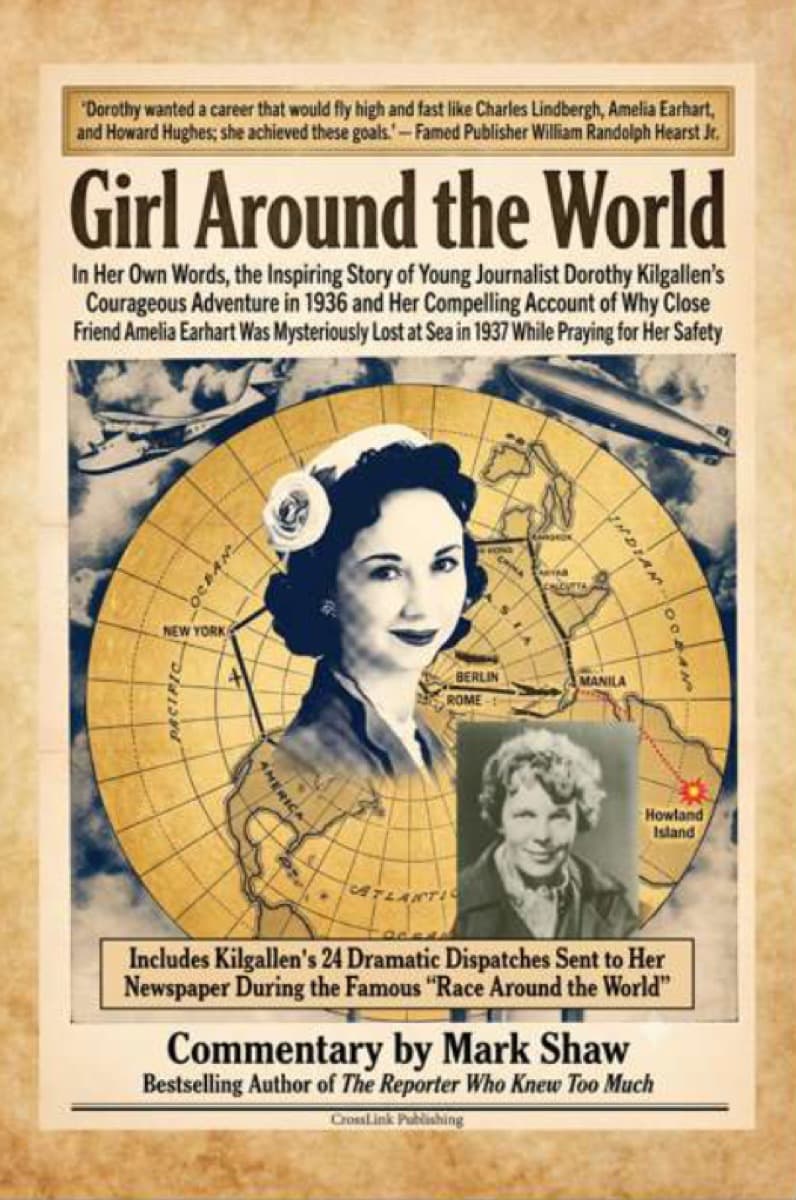
What really happened to legendary aviator Amelia Earhart when she was lost at sea in 1937? A new book, “Girl Around the World,” by Mark Shaw sheds new light on the mystery through the account of the aviator’s kindred spirit, reporter Dorothy Kilgallen.
Through Kilgallen’s own words, including the two dozen dramatic, colorful dispatches she sent to her newspaper during her famous 1936 “Race Around the World,” Shaw draws parallels and reveals a strong bond between the two women.
On Sept. 30, 1936, Kilgallen, a 23-year-old crime reporter for the New York Evening Journal, set out on a race around the globe against two older male reporters, one with The New York Times and the other with the World-Telegram. While the men had planned their trips well in advance, Kilgallen had only 24 hours’ notice, and all commercial flights between London and Hong Kong were booked. Armed with only a hatbox and a typewriter, she depended on strangers willing to give up their seats to the “journal girl,” as her paper called her, and on other modes of transit, including the Hindenburg.
While the underdog and sudden darling of the media didn’t win the race, Kilgallen made history. She traveled for 24 days, 12 hours, and 51 minutes after leaving New York, becoming the record-setting first woman to circle the globe — including through Asia, where her plane crashed and 600 natives, nearly naked, surrounded the plane.
In his new book, released in September 2026, Shaw reveals how Kilgallen’s travels on the China Clipper followed a similar flight plan during her “race” to that of Earhart’s in 1937. In fact, on July 6, 1937, when Earhart was lost at sea, Kilgallen wrote a column based on her 1936 experiences, offering her expert take on “solving” the mystery of what happened to Earhart.
“Weather is the peril of the Pacific,” she wrote. “Weather that changes with the whim of a light wind and stirs up the water and churns the air while you watch it, and makes sky passage dangerous. There are no signposts in the ocean…I think her instruments went bad, her radio went bad, and her gas ran low while she was trying to navigate by second sight or a hunch. My heart is with Amelia Earhart today, wherever she is — and I pray that wherever she is, she is safe.”
The book was published within a month of Shaw’s alma mater, Purdue University — where Earhart was a faculty member at one time — leading an expedition to the Pacific islands to find evidence of Earhart’s lost plane.
Since Kilgallen’s 1936 travels echo those of Earhart’s flight in 1937, Purdue faculty and expedition leaders have been given access to Shaw’s research, which offers a never-before-told perspective on the lives of these two women by exposing little-known facts about them in context with their adventures in the 1930s, according to officials with the book’s publisher.
In fact, Shaw says that Amelia Earhart was an avid follower of the “Race Around the World” and wrote Kilgallen an encouraging message: “I know you can make it, Dorothy, but you must follow your normal schedule of eating, drinking, and sleeping, even though on such a trip … Forget you are flying and you won’t become air weary.”
The book, published by CrossLink Publishing, is available in hardcover for $29.95 and as an ebook for $9.99.
For more information: MarkShawBooks.com
Leave a Reply