

The flight departed West Houston Airport (KIWS) in Texas, and flew to Wharton Regional Airport (KARM) in Wharton, Texas, where the pilot performed air work and four landings.
On the return to KIWS, he performed a touch-and-go landing at Covey Trails Airport (X09) in Fulshear, Texas. While performing the landing on Runway 35 he said the engine indications appeared normal.
The pilot told investigators that the flight was departing to the northeast at about 700 feet when he smelled a “weird smell,” then several seconds later he heard a “loud explosion.”
He reported the airplane shook violently and was hard to control. The engine lost all power, so he attempted a turn back to the airport to land on Runway 17.
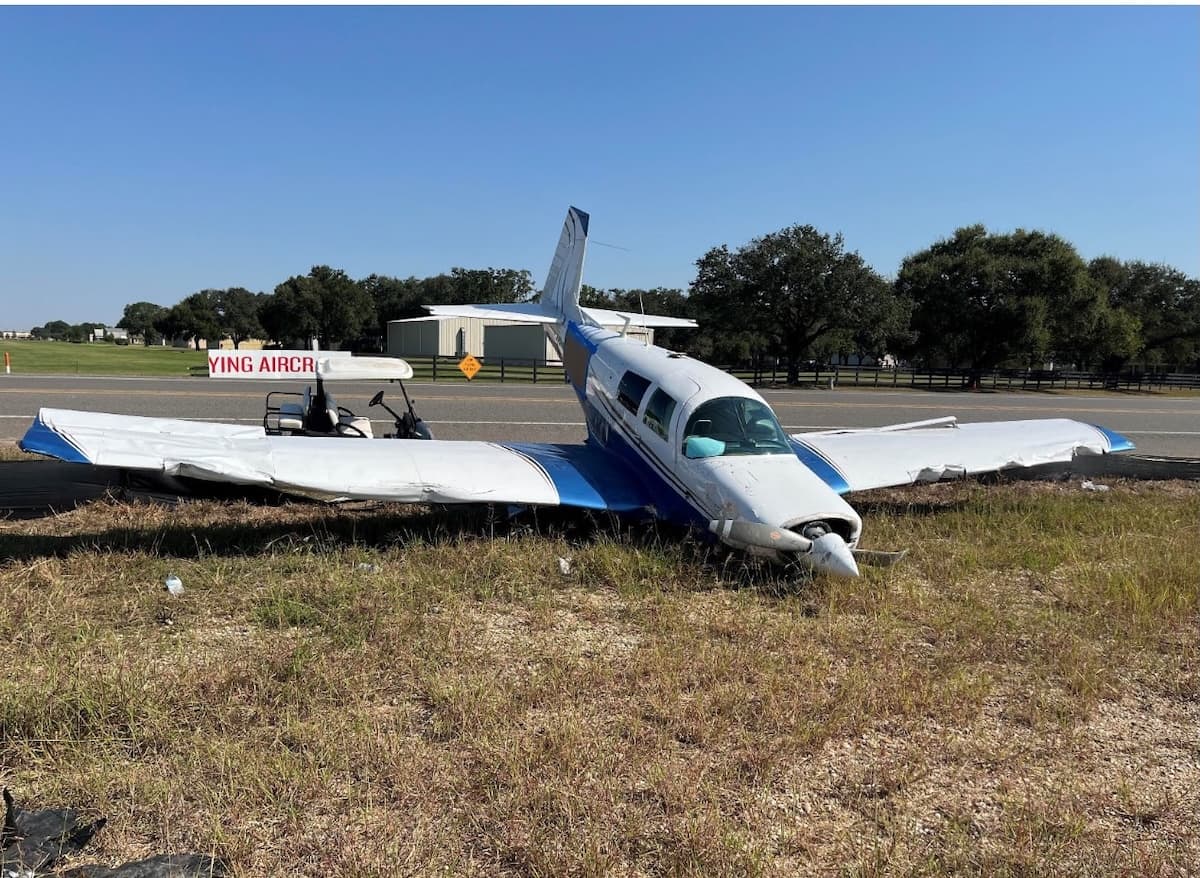
He said there was a 14-knot tailwind, so he had to slip the airplane onto the runway and it touched down within the first 1,000 feet at about 70 knots. He used the brakes on the grass surface, but was unable to stop before the airplane overran the end of the runway and came to rest in a ditch about 150 feet south of the runway. The pilot and his passenger were not injured in the crash.
A post-accident examination of the airframe showed that the original engine cowls had been modified via Supplemental Type Certificates (STC) with fiberglass fairings at the front of the upper and lower cowl where air flows into the engine compartment. In the left front corner of the engine compartment, a vented baffle had been added to direct airflow to the heater muff air inlet hose, which would have been affected by the additional cowl fairings. The upper cowl fairing was missing and the lower cowl fairing was damaged. The vented baffle also had damage present.
The spinner and spinner mounting bulkhead were both missing a portion of their assemblies. The separated portions of these two items were not present at the accident site. The interior of the spinner showed rotational damage and the internal bulkhead that seats the spinner on the propeller piston dome was offset to one side, consistent with the damage having occurred while the engine was running.
The propeller blades had gouges and scratches on the blade faces near the blade roots along with white paint transfer marks. The blade backs had scratches that marred the painted surface at the outboard end of the blades. One blade was bent aft at the outboard end and the other blade was bent aft about mid-span.
Post-accident engine runs revealed no anomalies that would have precluded normal operation.
Recorded data was obtained from the JPI EDM-900 engine monitor and the Avidyne IFD 540 nav/com radio. The two data sets were time-correlated to one another and reviewed. The last two minutes of the data showed the airplane made a touch-and-go landing at X09 followed by a northeasterly departure from Runway 35.
At 12:33:50, the data indicated Fuel Flow (FF), Manifold Air Pressure (MAP), and Exhaust Gas Temperatures (EGTs) decreased consistent with an engine power reduction. This occurred just before the 180° turn to return to X09.
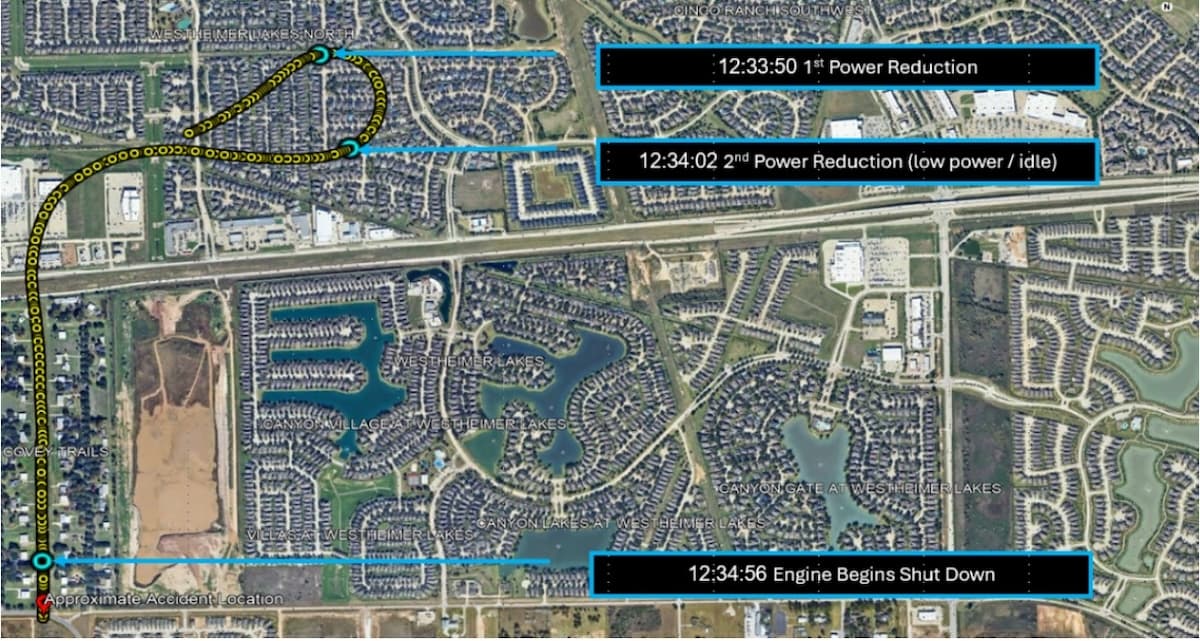
At 12:34:02, the data indicated that FF, MAP, and EGTs decreased a second time to values that were consistent with the engine at a low or idle power setting, similar to values seen earlier in the data during the landings at KARM. This occurred after the 180° turn had been completed and the airplane was headed southwest, toward Runway 17 at KARM roughly 0.6 nautical miles (nm) away.
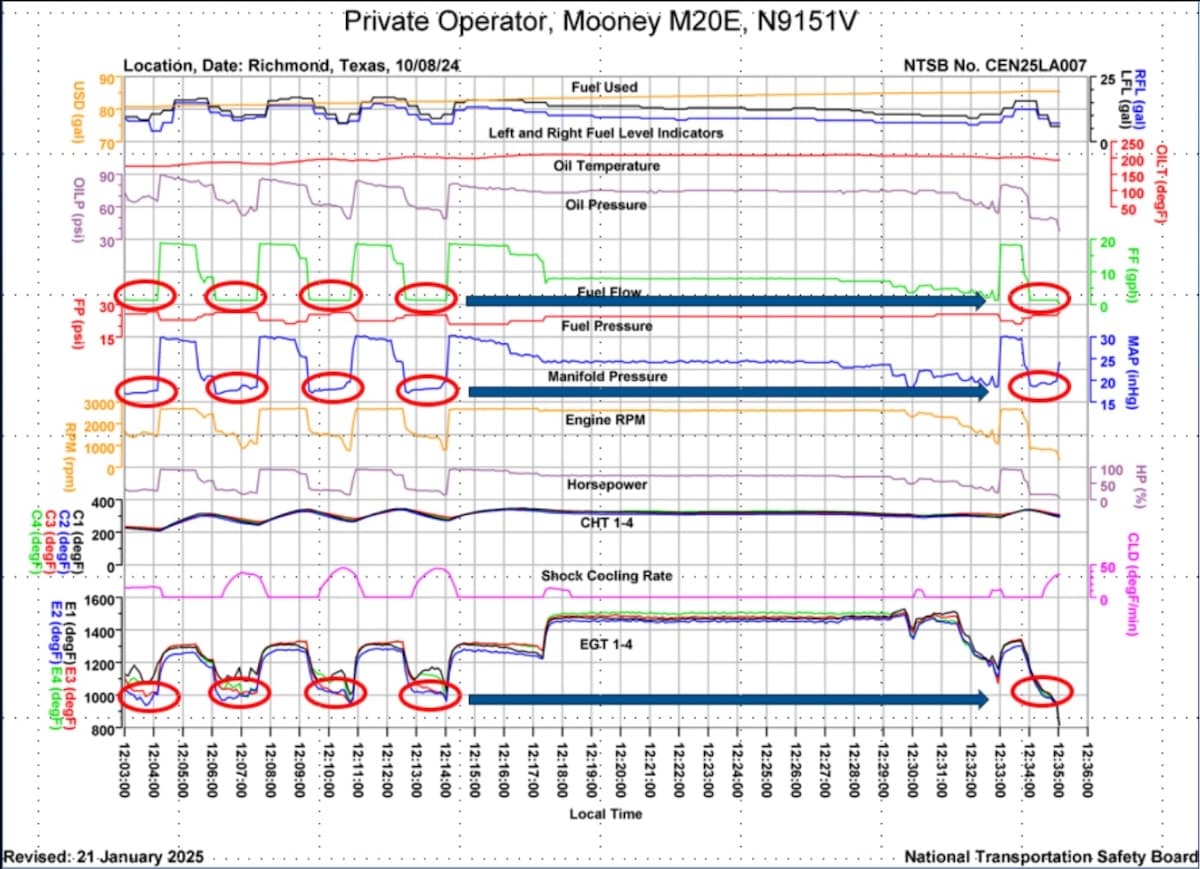
At 12:34:56, the data indicated that FF reduced to zero, MAP increased, and EGTs decreased. This occurred roughly 500 feet before the end of the runway and is consistent with the engine being shut off.
At 12:35:03, the data was consistent with impact. Impact occurred 46 seconds after the completion of the turn back to the airport when the second engine power reduction to low or idle power took place.
Probable Cause: The partial separation of a portion of the propeller spinner and its mounting bulkhead along with the upper cowl fairing while in a full-power climb.
To download the final report. Click here. This will trigger a PDF download to your device.
This October 2024 accident report is provided by the National Transportation Safety Board. Published as an educational tool, it is intended to help pilots learn from the misfortunes of others.
Leave a Reply