

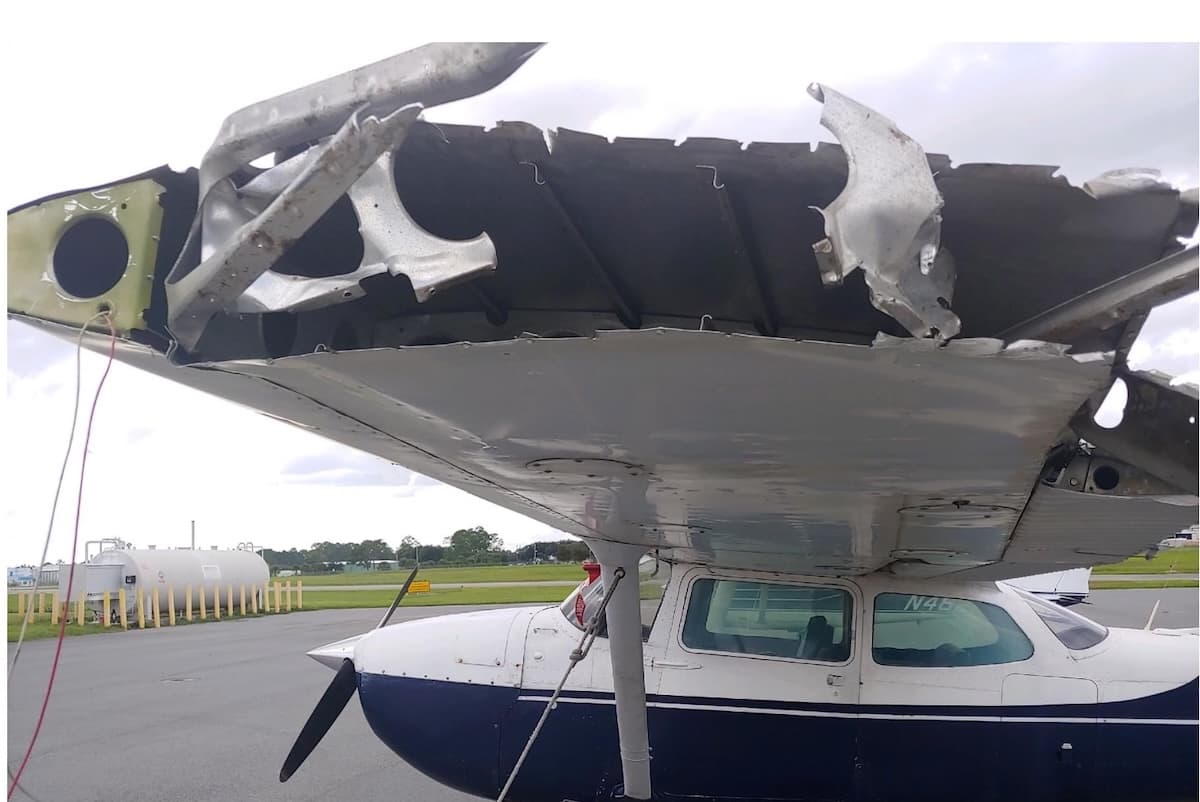
The flight instructor explained that immediately after the Cessna 172L lifted from the runway at the airport in DeLand, Florida, a parachutist beneath a fully deployed canopy appeared from above and to the left of the high-winged airplane about 15 to 20 feet above ground level.
The parachutist was aligned to cross the runway from left to right immediately to his front, so he turned right to raise the left wing in hopes of striking the parachute instead of the parachutist.
Witnesses described the collision, pieces separating from the airplane, and the parachutist “skidding” across the runway before coming to rest unhurt.
The instructor maneuvered the substantially damaged airplane and landed it successfully with both occupants emerging unhurt.
According to the skydiving operator, the parachutist failed to enter the area surrounding the designated drop zone properly and into the wind, instead overshooting the landing zone in the downwind direction and crossing in front of the departing airplane.
In a written statement, the parachutist explained that he was a “student” and that he lacked control of the canopy when he experienced a “sudden change of winds.” He stated that the wind “pushed” him in the direction of the departure runway.
The parachutist added that because he was a student in a “highly good” training environment, he would improve his “skills and experience” with more training.
Probable Cause: The parachutist’s failure to control his canopy which resulted in a downwind landing, an overshoot of the drop zone, and collision with a departing airplane.
To download the final report. Click here. This will trigger a PDF download to your device.
This September 2024 accident report is provided by the National Transportation Safety Board. Published as an educational tool, it is intended to help pilots learn from the misfortunes of others.
Leave a Reply