

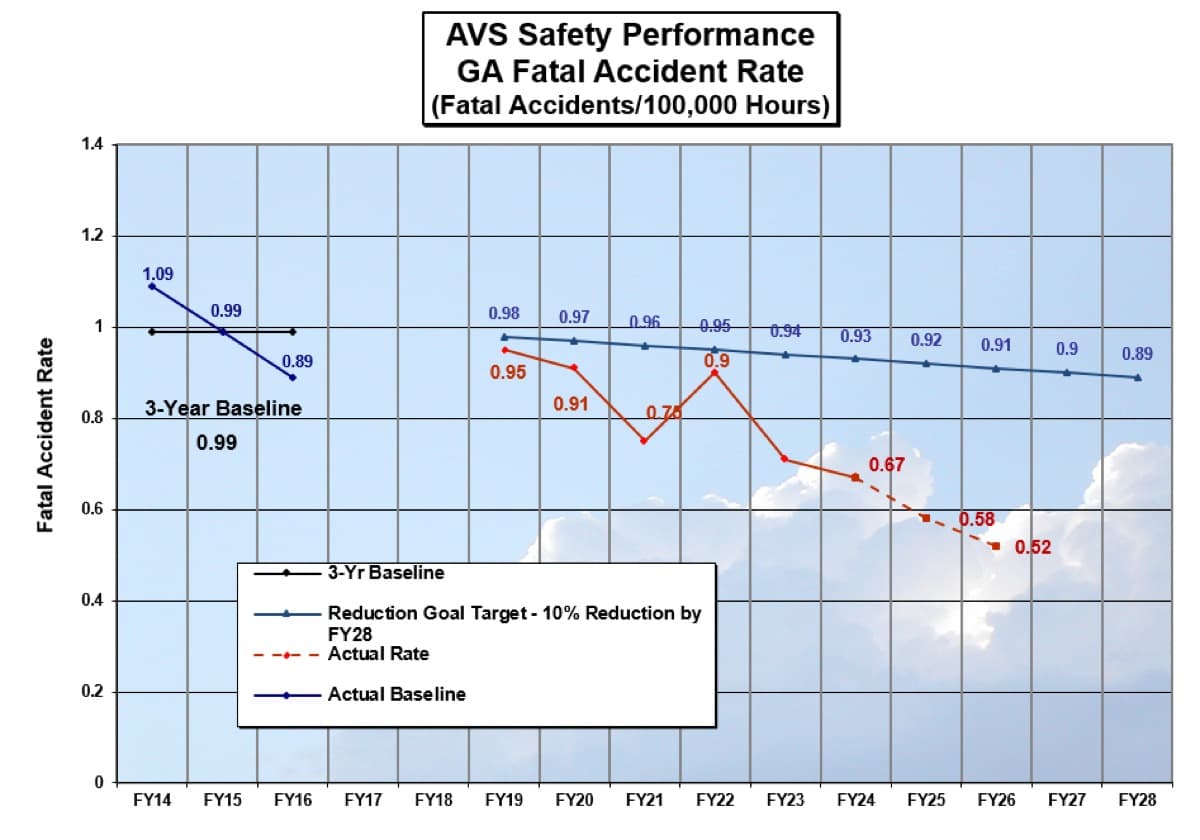
The latest issue of the FlySafe Flyer from the General Aviation Joint Safety Committee shares some good news about the general aviation fatal accident rate for fiscal year 2026.
As of Aug. 24, 2026, the estimated GA fatal accident rate is at 0.52 accidents per 100,000 flight hours, which is well below the yearly reduction target of 0.91. The fiscal year began Oct. 1, 2025, and runs through Sept. 30, 2026.
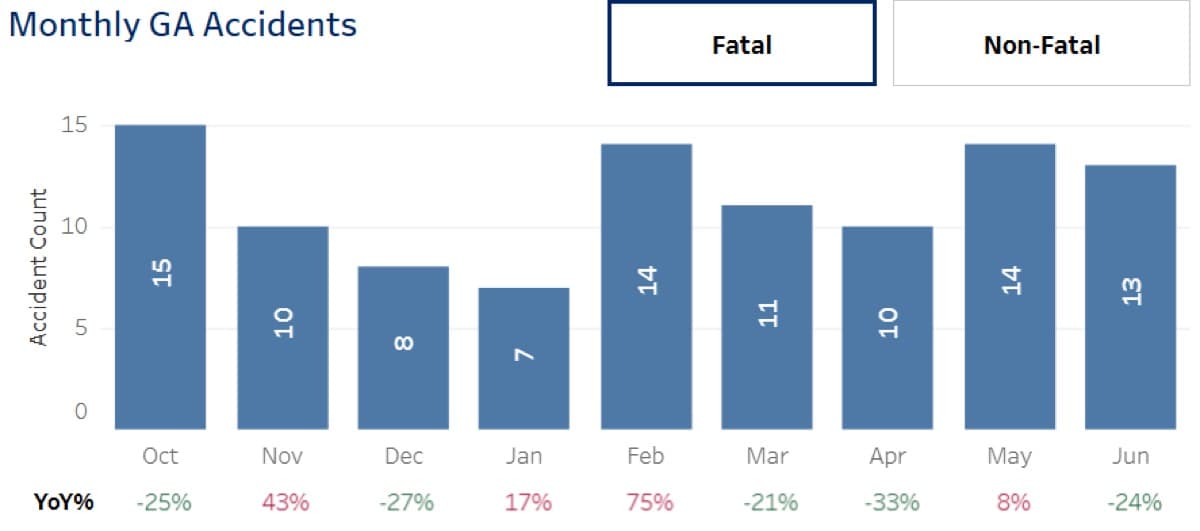
There’s also a chart that breaks down the fatal accidents by month through July of the 2026 fiscal year:
Want to dig even deeper? Check out the Pareto chart on general aviation fatal accidents, which can be customized to display a specific date range of accident data and sort results by aircraft classification, FAR part, operational category, and accident category. You can see that here.
For more information: GAJSC.org
“the most popular aviation training academy in the US will not even let their CFIs fly solo!” Incredible. But I know of a somewhat similar type restriction. One of my students had to return to college where he finished his aviation training. That flight school did not allow stalls from a turning entry.
So is this better. What if we imposed restrictions on everyone equal to what we impose on a student’s first solo. We could get the accident rate to near zero. But what do we have? People in authority making restrictions – not necessarily safer pilots.
I wouldn’t put too much confidence yet in mid-year numbers of one year.
Does it mean that the cost of insurance will drop down?
Generally, for any insurance coverage, premiums would go down when the company has paid less in claims. A lower accident rate wouldn’t necessarily mean lower claim costs to an insurance company since there are other factors in the equation – i.e. inflation, tariffs, labor.
For many veteran CFIs and examiners, the continuing drop in aviation accidents is a surprising, but gratifying, enigma. Why is the accident rate dropping with a preponderance of accelerated training leading to less experienced pilots (CFIs with only 10 hours of real solo) and less skilled pilots (the opinion of 86% of DPEs polled)? Wouldn’t less skill and experience lead to *more* accidents?
My theory is that the 2016 change to the ACS testing standards (driven by SAFE’s Flight Training Reform Symposium in 2009) made risk management and judgment a central focus in pilot training. Most of today’s active pilots were trained with risk management as a critical core tenet. Every FAA testing standard – and hence training course – focuses on choosing a safer path; the “conservative response rule”.
I think that despite diminishing experience and skill levels, better judgment leads to safer aviation. Embedded safety standares also help; the most popular aviation training academy in the US will not even let their CFIs fly solo! Perhaps the once-common “macho pilot” mentality – and “the right stuff myth” – is finally a thing of the past.
I agree with your points…then I read something like today’s GAN NTSB accident case: “Botched Go-Around Leads to Crash”…
and I wonder how much blame do we place squarely on the CFI(s) shoulders?
https://generalaviationnews.com/2026/08/28/botched-go-around-leads-to-crash-2/
How does this training academy meet the requirements of 61.109(5) for their private students? Without yall having to look it up, it’s the solo time requirement.
The 10 hours mentioned are the Private requirements. The Commercial does not require solo if you meet this requirement – “10 hours of flight time performing the duties of pilot in command in a single engine airplane with an authorized instructor on board”. And the CFI does not require solo.