

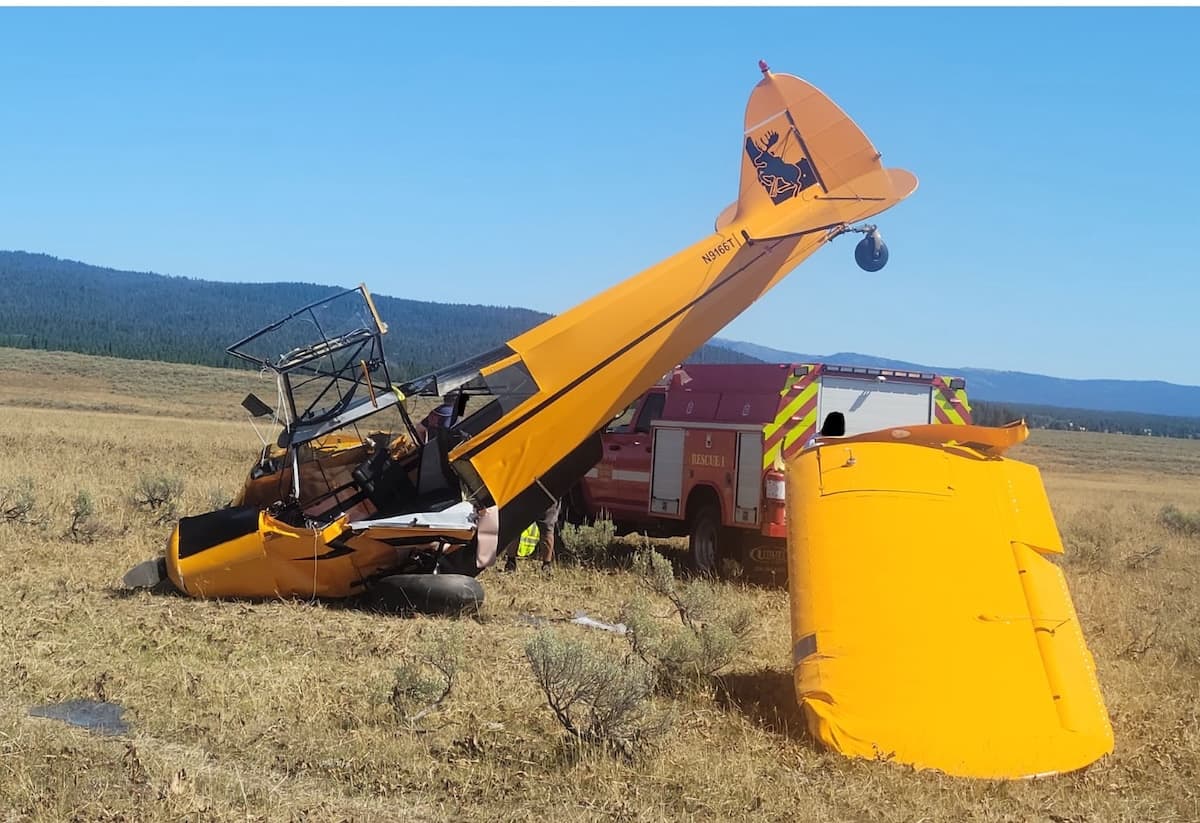
The pilot told investigators that during takeoff at the private airport in Island Park, Idaho, the Piper PA-18-150 abruptly rolled to the right.
He attempted to correct this by applying full left aileron and rudder inputs, but the airplane did not respond.
Subsequently, the right wing tip hit the ground, followed by the nose of the airplane, resulting in substantial damage to the fuselage and both wings. The pilot was seriously injured in the crash.
After the accident, water was observed draining from the interior of the right wing around the wing root.
According to the pilot, the airplane had been exposed to heavy rainfall the night before the accident. He further noted that water had accumulated in the wing prior to takeoff and that he had no means to detect or remove the water before takeoff.
Probable Cause: A loss of lateral control during takeoff due to an accumulation of water in the right wing.
To download the final report. Click here. This will trigger a PDF download to your device.
This August 2024 accident report is provided by the National Transportation Safety Board. Published as an educational tool, it is intended to help pilots learn from the misfortunes of others.
“Despite Scott’s immediate and full left aileron and rudder inputs, the airplane did not respond.”
I’m playing devil’s advocate; but respectfully, something is not quite right.
A lightly loaded, highly-modified 160 HP Super Cub (SC) tries to take off from a 3,125’ gravel strip at 6,600’ MSL and loses control because of a massive asymmetric weight imbalance caused by water trapped in the right wing.
Probable Cause: “A loss of lateral control during takeoff due to an accumulation of water in the right wing.”
The idea that enough water could ”accumulate” in just the one wing, undetected, to cause a complete loss of control, is a bit of a stretch.
The Form 6120.1 is missing some key info, like the pilot’s experience in that make/model. But it does include his assumptions & speculations about the ‘accumulation’ …that aren’t actually addressed by the NTSB. I’m surprised they didn’t travel to the site, despite his extremely detailed pilot “narrative” and “Recommendation to the NTSB”. I’d hope there is more NTSB and FAA info that isn’t in the attached Docket.
The pilot “strongly believed that rainwater infiltrated the aircraft’s Wings during the storm the night before the takeoff” …but it’s never proven that was the ONLY reason it crashed.
Water did drain post-crash near the wing root; so, we definitively know some was trapped inside the wing. But how many gallons of water, at 8.34 lbs./gallon, would have to “infiltrate” the right wing to render a SC unresponsive to flight control inputs? We don’t know exactly how much water was “accumulated” because none was captured after the crash. We also don’t know if/how much water was absorbed & held in ‘suspension’ by saturated fabric.
This SC had Atlee 30.5-gallon wing tanks (61 gallons total, not the reported “70”) but had only 11.5 per tank. It’s carrying roughly 1/3 of the total Avgas (6 lbs./gal) ‘weight’ available (138 lbs. vs. 366 lbs.). Granted, we know the water didn’t leak into the right fuel tank…
We also know location makes a huge difference since Weight x Arm = Moment. But without burning up my calculator batteries, even at 8.34 lbs./gallon, it seems like it would take LOT of water, e.g., many, many gallons, to result in the flight controls “not responding”.
According to the pilot, “…it is likely that water entered the wings and due to the apparent absence of grommets (weep holes) designed to allow water to escape, became trapped.”
Maybe if it were trapped at the wing tip…that’d be a big ‘moment’ to overcome …but since it was draining out at the wing root, that means at least some water was sloshing around freely inside the wing.
The pilot noted “…that he had no means to detect or remove the water before takeoff”. However, the NTSB listed “Preflight inspection – Pilot” under “Personnel issues”. Why?
Just my guess, but all that water would’ve been sitting inside on the lower wing skin. That’s why I always ‘thump’ the fabric with my hand and rock the wings…gently…during preflight. If gallons of water sat inside the wing, you’d “feel” it. OTOH, seems like the airplane would also be sitting a bit wonky on the ground with that much of an imbalance.
It’s not clear how that much water entered the wing; cracks/holes/seams/inspection panels …or absorption through the fabric?
The rebuild was completed on 6/29/2023; an annual inspection was conducted in 6/2024; the accident occurred on 8/19/2024.
If the brand-new fabric had deteriorated that badly in 14-ish months, wouldn’t it be readily apparent during any visual inspections?
He essentially blames Yakima Aerosport for doing a poor recovering job. They are a pretty reputable shop: It’s hard to imagine they re-skinned a plane so badly that the right wing could drink and retain that much water, even in a deluge.
Rhetorical question: You’re taking off from an “unobstructed”, high altitude, gravel strip, with calm winds, in a high-performance taildragger, and the plane is ready to fly off at 50 KIAS: Why would you hold it on the ground, with increasing forward stick pressure, until 60 KIAS? Flap use is optional…
I guess whoever recovered the aircraft forgot to put the drains in the wings. There are consequences to not doing things correctly.
The builder of the experimental I bought installed the wing drains on the fabric but forgot to open them. I went around and popped them cleanly open with a quick touch of a hot soldering iron.
Amazing how some people are so helpless in the accidents they cause through poor judgment. Some pilots shouldn’t have a license.