

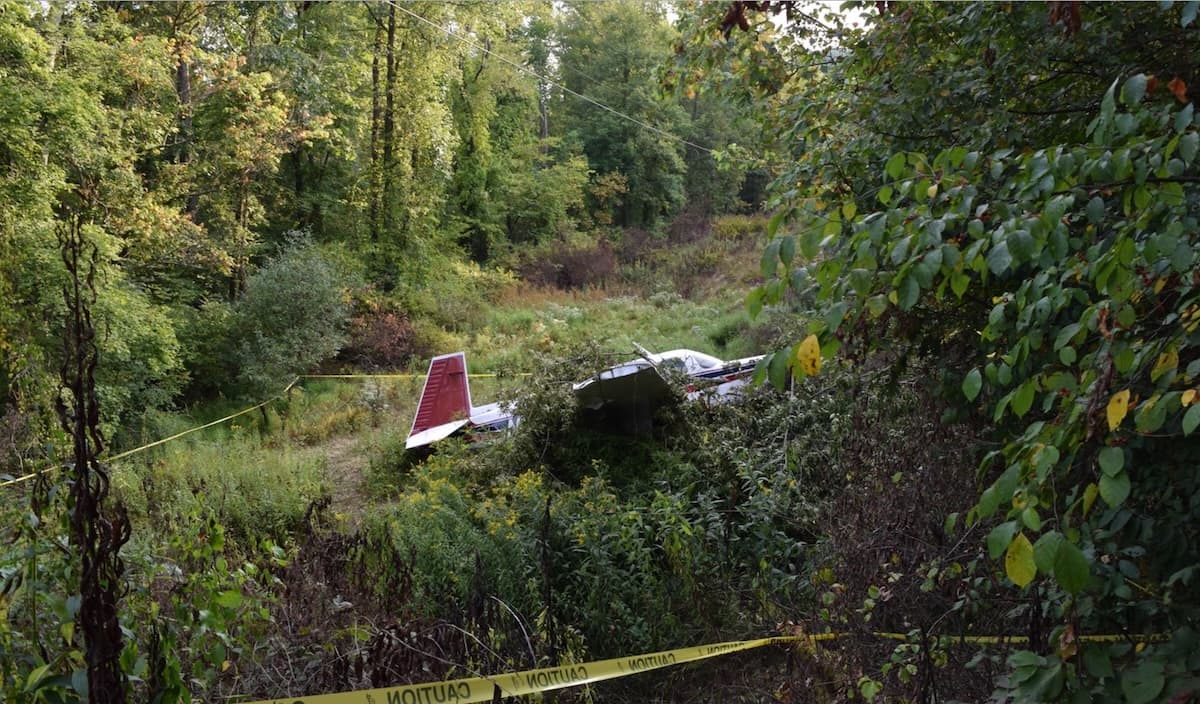
While en route to his destination, the pilot diverted to an alternate airport due to low cloud cover. After reviewing the runway length at the airport in Fairmont, West Virginia, he overflew it, then entered the airport traffic pattern for landing.
He turned onto the base and final legs of the airport traffic pattern, and while on final approach, he recognized the Mooney M20K was fast, but continued the approach.
He told investigators that the airplane touched down too far down the runway, with a witness indicating that the airplane touched down past the last crossing taxiway, which resulted in about 836 feet of runway remaining.
After touchdown, the pilot applied the brakes momentarily, but in that instant, he knew he was fast and added power to abort the landing. The engine responded and he fully retracted the flaps.
During the climb-out, the airplane hit trees and then the ground. The airplane’s fuselage and left wing were substantially damaged. The pilot sustained minor injuries in the crash, while a passenger sustained serious injuries.
Probable Cause: The pilot’s failure to attain the proper touchdown point, and his delay in aborting the landing.
To download the final report. Click here. This will trigger a PDF download to your device.
This August 2024 accident report is provided by the National Transportation Safety Board. Published as an educational tool, it is intended to help pilots learn from the misfortunes of others.
Practice what you fly….
This is ludicrous:
Something that may useful –
Whenever I practiced ILSs I would keep the throttle where it was when I intersected the glideslope. I kept the flaps and gear up too. By the time I got to minimums I was indicating 140. It was quite challenging.
Most runways in the US are much longer than what’s required by the book. Few pilots feel motivated to train shortfield landing techniques.
In my country runways are much shorter so pilots‘ skills are constantly honed to bring your aircraft to a safe stop before running out of runway.
During a recurrent training in the US I was showing around a photo a passenger had taken on final approach from the right seat of our corporate King Air, showing the runway ahead of us,.
The reaction of other pilots in my course was: „… but you haven’t landed there?!“
Of course I have! That short runway was my home base.
Precision and discipline starts from the first hour.
Very correct. The first hour is important. It is the beginning.
“Probable Cause: The pilot’s failure to attain the proper touchdown point, and his delay in aborting the landing”
I’d say the “probable cause” was poor decision making along with poor piloting skills as the result of poor training which led to said pilot failing to attain the proper touchdown point, etc…
3,000 just about qualifies as a short field landing in a M20K. He diverted even though he listed on the NTSB as instrument rated with a little over 48 hours actual, but only 52 simulated with 1429 PIC.
Fwiw, my wife would never be a go for an approach into the fog, even though I maintained currency. I wonder if that was a factor. But you can’t be indecisive about going around in a Mooney, everyone who flys them knows that.
Something that may useful –
Whenever I practiced ILSs I would keep the throttle where it was when I intersected the glideslope. I kept the flaps and gear up too. By the time I got to minimums I was indicating 140. It was quite challenging.
Whenever I needed to set down into the fog I’d do things the standard way and take it easy at 90. Those were always a piece of cake in comparison.
The sloppiness in some of general aviation is amazing. Can’t touch down on the numbers, can’t takeoff or land on the center line. Just plain sloppy and unacceptable. Instructors push your students to be better pilots. The accident rate would come way down.
What we need at this point is someone to push the instructors to be better pilots. I’m an inactive private pilot who rode along when my son took an introductory flight about 12 years ago and the “Flight Instructor” handled the 172 in the pattern and landing like he was flying a Learjet. 90 knots over the numbers with 10 degrees of flaps all the way to the runway. Landed at about 70 knots, about 1000 feet down the runway and did a high speed exit like something from a bad movie. That was the only time I have ever been in an airplane and wishing I wasn’t. Far too many time builders and far too few truly professional flight instructors, IMHO.
Two Things You Hear one in Surgery / One on FINAL ….You’re STABILIZED