

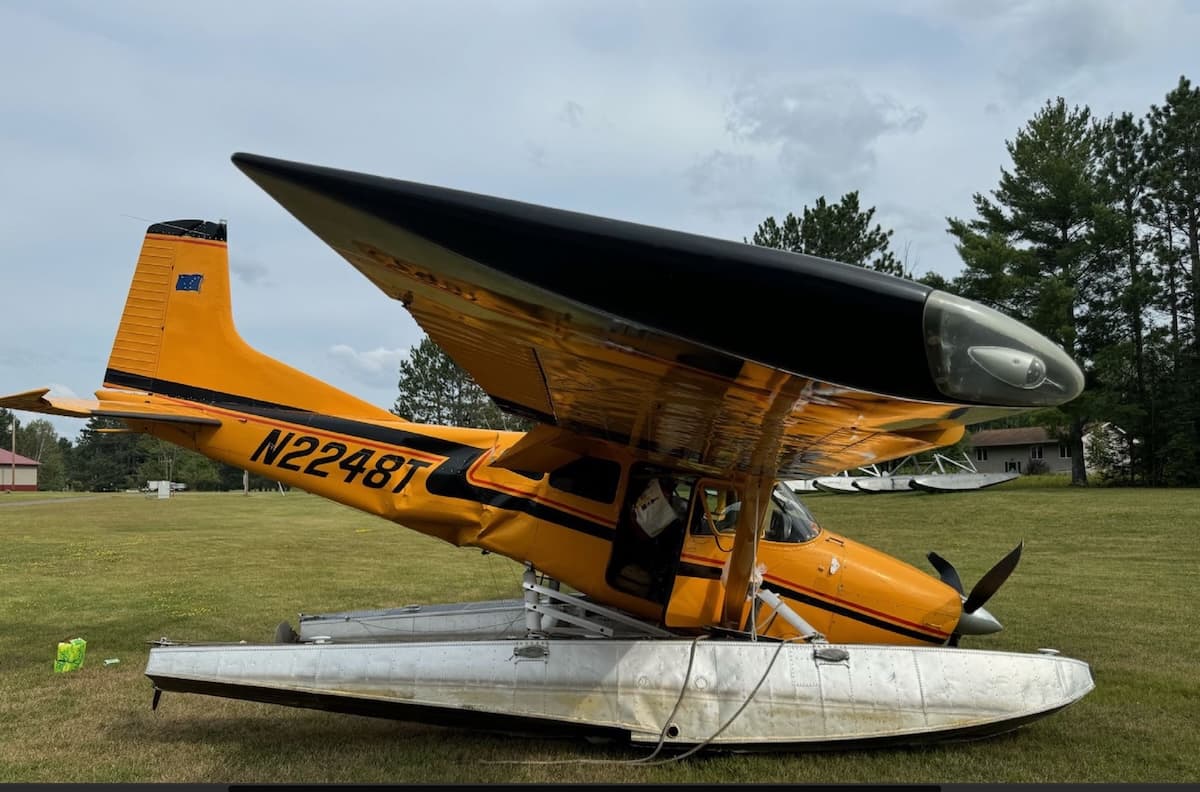
The pilot reported that shortly after takeoff from a lake near Eveleth, Minnesota, at an altitude of about 75 feet above ground level, the Cessna 185’s engine suddenly stopped operating.
He made a forced landing to an open area of grass at the seaplane base.
The pilot told investigators that the airplane touched down very hard with the wings level and skidded upright about 150 feet. The airplane sustained substantial damage to the fuselage during the hard landing.
A post-accident examination revealed that the wing fuel tanks remained intact. The fuel tanks were drained of fuel by the recovery company and the fuel was collected into a container. About 30 gallons of fuel consistent with 100LL aviation fuel was collected.
The fuel tanks had rubber bladders, both with wrinkling on the lower surface, as shown in Figure 1. The fuel vents were not obstructed.
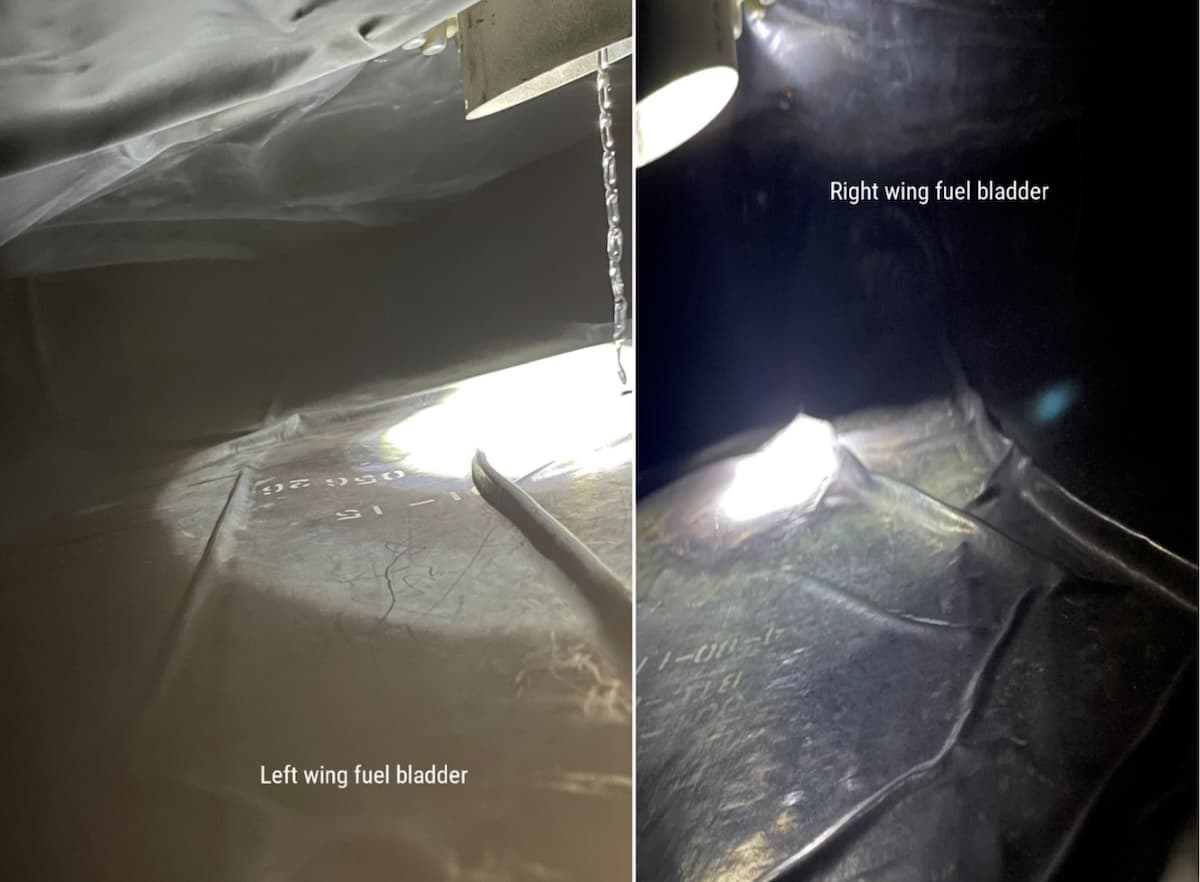
The left- and right-wing fuel cap seals exhibited deterioration and discoloration around the outer surface, but were otherwise pliable. The fuel cap sealing surfaces on both wings were corroded.
The fuel that was collected at the accident scene tested positive for water with water finding paste. A visual examination of the collection tank revealed about 1 gallon of water in the bottom of the tank.
The pilot told investigators that the airplane had sat outside during a significant rainstorm a few weeks before the accident. The airplane was flown after the rainstorm in smooth air and had sat again for about two weeks before the accident flight.
The pilot drained the fuel and checked for water before the flight, but did not observe any water contamination.
He added that after taking off, the airplane made a significant yaw shortly before the loss of engine power. The pilot noted that on the day of the accident, the wind was gusting and the air was bumpy.
An Airworthiness Directive (AD), 84-10-01 Bladder Fuel Cells Revision 1, was issued on Oct. 4, 1986. The AD requires a fuel cell fluid retention test and recurrent inspections of the fuel cells to prevent power loss or engine stoppage due to water contamination of the fuel system. The AD lists the inspection steps and remedial actions necessary. The AD gives two options if inspection of the fuel cells reveals more than 3 ounces of fluid. One option is to fabricate and install a placard detailing instructions to check for fuel contamination during preflight. A second option is to install reduced diameter (raised filler neck) fuel caps on all fuel filler openings.
Compliance with the AD was not properly recorded in the airframe log, however, the airplane had reduced diameter fuel caps installed, which complied with the AD. Additionally, recurrent inspections required by the AD no longer apply with the installation of the reduced diameter filler caps.
Probable Cause: Water contamination of the fuel system which resulted in a total loss of engine power. Contributing was the pilot’s inadequate preflight.
To download the final report. Click here. This will trigger a PDF download to your device.
This August 2024 accident report is provided by the National Transportation Safety Board. Published as an educational tool, it is intended to help pilots learn from the misfortunes of others.
you said it exactly right Peter H.
I wish all of the aviation thought like you.
Two problems here. First replace your o-rings every year or two on the fuel caps. Would have saved this plane. Second this plane was stalled in. First sign of power loss get the nose down for best glide speed and take it to 3 feet off the ground then flair. Get your glider license and learn how to fly. Power pilots are always pulling back hurting themselves and the plane.
LT, I’d “flare” at three feet. If a pilot were to “flair”, I think he’s still going to crash. 😉
How about rocking the wings first, complete the pre-flight, and sump the tanks last? Also, many might be surprised how many pilots don’t know to check the gascolator. I knew a pilot (an owner) who flew for at least 5 years and never knew that there was a sump for the gascolator, or that the plane even had a gascolator. When I told him about it, he asked what it was. Yikes.
Unfortunately, this event illustrates how regulations and approval processes have created an environment where an entire industry sector (general aviation) has an opportunity to commit collective suicide – and the sector is taking full advantage of this “opportunity”.
I had replaced the notoriously leaky Cessna fuel caps with simple, but effective (FAA-approved) raised fuel caps many years ago when I stored my 185 outside because hangars were not available. Unfortunately, a couple of years ago I got distracted while fueling my 185 and I neglected to re-install the fuel cap on one tank. It subsequently blew off on takeoff as it was designed to do, and unfortunately it was nowhere to be found.
You wouldn’t think that would be a big deal and I contacted the manufacturer to get a replacement. And that is where the collective industry suicide comes in – they wanted almost $500 for a replacement!!
It is no wonder thousands of airplanes fly around with known, poorly designed and poorly functioning components. It is an expensive hassle to get better, commonsensical replacement components through the FAA paper mill and as a consequence, such FAA-approved components are then priced as if they were made from pure gold. So while MOSAIC may solve some problems, it still leaves untold thousands of airplanes so expensive to own that they will eventually end up in the scrapyard. When will the FAA fix this situation?