

What if we designed aircraft, and their systems, to prevent loss of control accidents? What would that look like?
Something like Cirrus Aircraft’s Safe Return Emergency Autoland…But more. Lots more.
Auto manufacturers have added various levels of self-driving systems in today’s cars. Why not aircraft?
Sure, we have autopilots, and the aforementioned Autoland in certain aircraft, but I’m thinking of holistic aircraft and systems that won’t let the aircraft harm its occupants or those on the ground below.
This needn’t be a “2001: A Space Odyssey” moment. Hal will indeed open the pod bay door, he just won’t let you stall the aircraft.
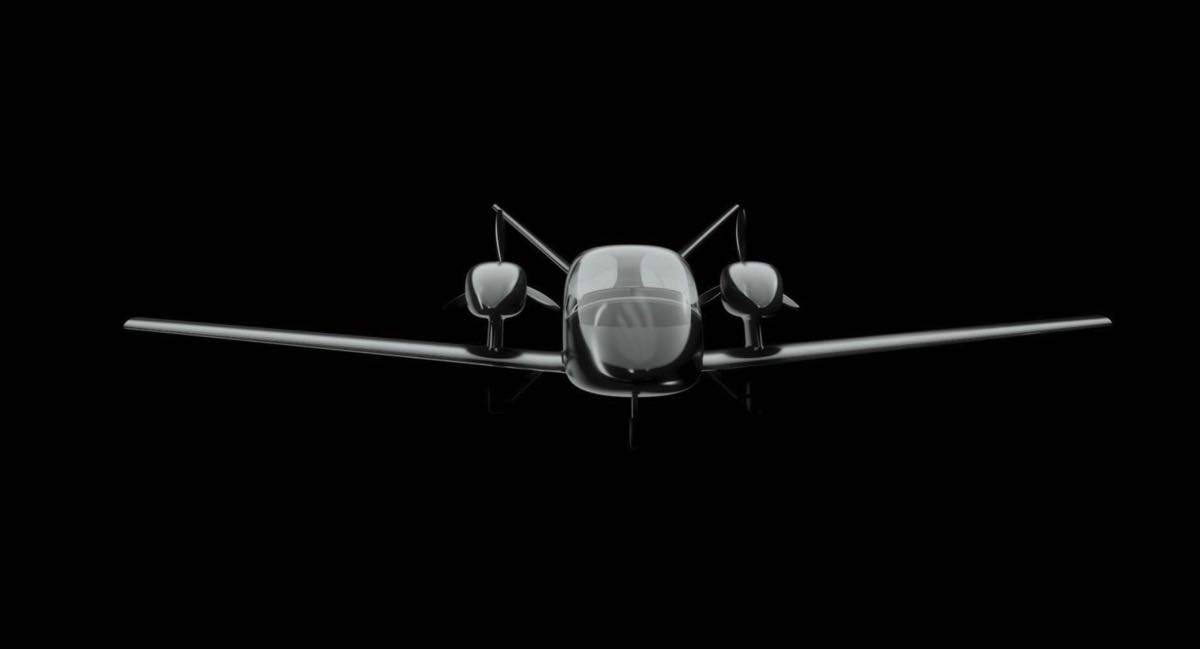
For those unaware, like I was until very recently, Skytron is a small team of developers seeking to bring a new four-seat, twin-engine plane to market.
From the company’s website: “Full envelope protection won’t let you stall, spin, or fly into terrain. Prevents the piloting mistakes that cause 80% of accidents.”
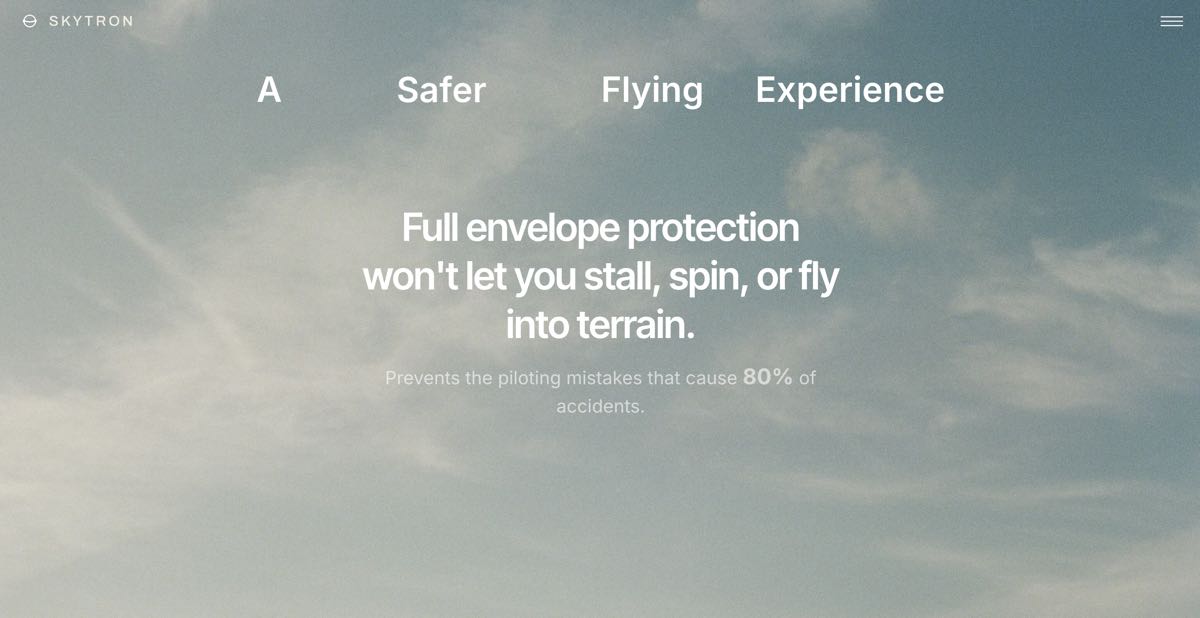
That is a bold statement.
But why not?
If you get to start from a clean sheet of paper and have access to a recently updated certification pathway, courtesy of MOSAIC, why can’t this become a reality?
The company’s videos and website lay out some of how it plans to accomplish such a lofty goal:
- Redundancy. Check.
- Airframe parachute. Check.
- Three flight control computers. Check.
- Loads of sensors and data paths. Check.
- Multiple independent power supplies. Check.
- Two engines. Check.
Out of the gate, Skytron officials state fly-by-wire and autonomy are at the heart of the aircraft.
“You cannot build this by taking a 1970s cockpit and taping AI onto the panel,” says Greg Mercer, Skytron’s co-founder.
The same likely goes for the airframe. It needs to be designed with the operating system in mind.
The company has selected Rotax’s 916iS engines, which produce 160 horsepower and are turbocharged. But most importantly, the engines come equipped with FADEC (Full Authority Digital Engine Control).
I wish I’d had FADEC on the Cessna 205 I was flying when the engine hiccuped. I was a distracted pilot, in a very busy cockpit flying through busy airspace, when I failed to properly lean the engine as we climbed. Everything turned out fine.
Skytron’s system would never let the hiccup happen in the first place.
When I wrote about it, I recall a few readers taking me to task for allowing myself to become distracted. I expected that. But one person said they prefered to manually fine tune the mixture for optimum performance. Good for them, but I’d rather let a computer optimize the fuel flow.
But that’s just me.
Will Skytron make it to market? Time will tell.
If it doesn’t, hopefully all the time spent at the keyboard designing the operating system that will make it all possible won’t go to waste.
But if it does succeed, all the better.
To be clear, this isn’t a system for the 1946 Piper J-3 Cub I have the privilege of flying. This will be for a whole new class of aircraft.
To the good folks at Skytron, keep me posted.
I’m rooting for you.

Becoming a pilot SHOULD be more difficult than writing a big check, turning a key and off we go. That’s the problem on highways, qualifications to drive a car are minimal and you see the results. (That’s one of the reasons I prefer to fly, most of the idiots are down on the ground.) Flying an airplane safely is more complex and more difficult than driving a car. In a car, if it starts to rain, you turn on the wipers (and the lights if you want to be legal). In an airplane, if it starts to rain you either shouldn’t have been there in the first place (VFR) or your workload has just gone way up (IFR). Car engines “just run”. Aircraft engines require participation. I’m not trying to be elitist, but some people really shouldn’t be pilots, just like I’ll never be a concert violinist.
I am a certificated Private Pilot and an Engineer in Silicon Valley. Technology should be used to make information readily available and to lighten pilot workload in the cockpit. The pilot has to be better trained for various scenarios. There are many variables to each flight. I wish there was spin training required for the PPL certification process. This continues to be a leading cause of death for low time Private Pilots.
If it’s designed and built by man, the pilot should be well trained and proficient, with the attitude he/she will be there for the inquisition if ever there needs to be one.
Mr Davisson is correct. After well over 10,000 hours of dual given, I observe that the basic understanding of the BASICS is disappointing.
I used to (after thr checkride was completed) set braking to nil, and max demonstrated crosswind and watch the 300 pax jet run off the runway side and crash. Then reset it and suggest that the pilot progress to using use full ailerons into the wind during the roll out. We went right down the middle of the runway until stopping.
I have watched more than one airline pilot land smoothly, on centerline, and tracking and pointing right down the centerline, and then asked if the owned a tailwheel light plane. The answer was always yes.
Buttonology and programming are necessary as well but real well executed hand flying is what saves the day.
Our training and certification standards are letting us down.
We still allow a pilot with a license obtained in a Pa-28 go out and buy a Luscombe or Cub get a tailwheel endorsement and then spin them in. It may not be loss of control as much as never having learned how to fully use the controls
A fully computerized aircraft with loads of sensors will still have things go wrong with it. They will just manifest in a different way. The computers will reduce stalls, spins and LOC, but now you get sensor errors, short circuits, and software glitches. One extreme example: The computer to decides to blow the parachute due to chafing wires. And we all know how easy it is to troubleshoot electric issues, not to mention avionics.
Not to mention the software will likely be proprietary meaning you need to hire the company technician to fix it.
Truly sophisticated engineering is elegant simplicity. The Spirit SE-1 or Vans aircraft come to mind.
An old Italian proverb: “The mother of idiots is always pregnant.”
Fortunately, my instructors were from the “Greatest Generation,” old school training.
Some people are just not cut out to be pilots no matter how idiot proof you make it.
As a flight instructor. I can teach you how to fly but making good decision’s is hard to teach.
And soon forgotten.
The basic piloting problem is lack of mechanical aptitude. Rote training and checklist dependency in lieu of undestanding cause and effect.
It was a great aircraft.
Too bad I must sell mine as time goes on it got me however not it
So when everything is controlled by a computer and won’t let you do certain things that can lead to disaster. Just look at what happened to airbus in the early years of development When the pilot tried to go around and the airplane wouldn’t let him and they crashed into the trees at the end of the runway in a fireball.
How to avoid a sailplane at 20,000 ft in the airway?
Fred Wieck attacked the idiot pilot syndrome with the Ercoupe in 1939. It was and still is the most simplistic, basically stall proof design. However almost all current, heavily computed retrieval and control systems are nothing more than crutches. The pilot is the weak link that is definitely NOT being addressed through improved training. As an 11,000 hour CFI who has spent most of his time flying with already licensed pilots, I have a VERY dim view of the abilities and basic understanding their original training imparted to them. It has continued down hill for decades. Forget computers, be more critical of CFIs and the over simplification of training aircraft.
If you dumb down the training in ANY endeavor, from balancing checkbooks to being able to read or understanding differences in political systems you get worse results across the board. Let’s make the pilot better at being a pilot from the very beginning.
Great post, Budd. My flight instructor always explained to me the why, and many times let me feel the results of mistakes at altitude. He took seriously his CFI mission of keeping the student and himself alive, and the airframe undamaged.
“Good enough” isn’t good enough. I told Steve not to ever let me be anything less than excellent, even if it “embarrassed” me. Better to be embarrassed than dead. In avaiation, perfect is not the enemy of “good”, it should be the standard that the pilot is always striving for in flying.
This CFII,MEI,AGI,BGI couldn’t have said it better, spot on!
Shades of 1940’s Ercoupes whom some hated because they would not stall or spin.
Perhaps it was way ahead of its time after all.
It already exists? Thorp designed it…the Piper Cherokee!
I’m surprised the article doesn’t mention Garmin Electronic Stability Protection (ESP). This should really cut back on spatial disorientation accidents. If your bank or pitch are outside of their safe envelope for more than a few seconds with the auto-pilot off, it nudges the plane back to safety. If ESP stays engaged for too long, the auto pilot comes on and returns you to level flight.
You just can’t idiot proof. There will always be a better idiot!
Exactly. Attempts to foolproof always fail, because fools are so good at what they do!
I agree with a previous comment- dead accurate fuel gauges would be a great start. Terrain avoidance (like my Garmin package) is invaluable.
Ben, you just can’s build an airplane that is pilot-proof. The real answer is better training for better pilots.
There have been many, many attempts to dumb-down the physics, which relentlessly stand firm no matter what, and real advances in tools to sharpen situational awareness but pilots seem to rediscover and explore “exceptions” to the limitations of physical law and their own limitations with alarming regularity.
The best approach to safe flight remains a well trained and well conditioned pilot. Those who aren’t are culled from the herd, tragically taking their unsuspecting passengers along for the ride.
Well if they can equip this aircraft with accurate fuel sensors and let the computer manage the fuel system, that would eliminate a lot of off-airport “landings” right there.
Yeah, and folks can apply for an ‘airplane driver’ license…..no pilot needed.!!! [sarc]
No thanks, I prefer to be ‘pilot in command’.!!
You mean …it’ll be kinda like a Tesla …on steroids. (I wonder if Elon reads GAN?)