

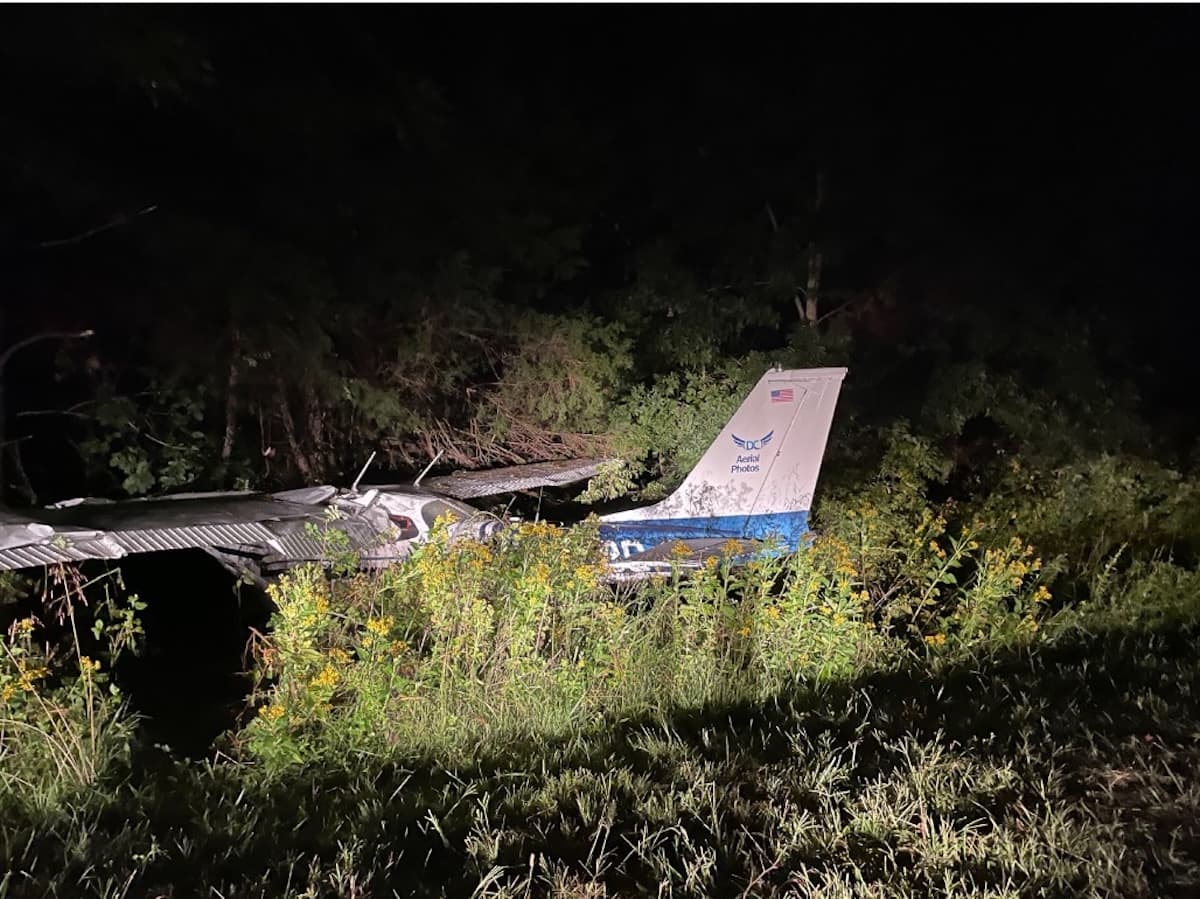
The pilot told investigators that the Cessna 172K had been stored in a hangar for two years awaiting an engine rebuild.
After the rebuild and an annual inspection, he planned to fly the plane back to his farm.
Following a preflight inspection, he attempted to start the engine but found the battery was too low. After a jump start, he departed, circled the airport, and headed toward the farm.
When the flight was about five miles from the farm, the engine lost total power, and he performed a forced landing near Fredericksburg, Virginia. After clearing trees along the approach to a pasture, he slipped the airplane to lose altitude and he began to flare the airplane about ⅓ of the way into the pasture.
He then noticed a gravel drive with utility lines and trees at the end of the pasture. He stated that since he still had sufficient airspeed, he pulled back on the control yoke, the airplane became airborne, and he was able to clear the utility lines and trees. The airplane then touched down hard. He told investigators that he ground-looped the airplane to avoid a river at the end of the pasture. The airplane hit the trees that he had just cleared before coming to rest.
The pilot sustained minor injuries in the crash.
During the post-accident examination of the airplane, about five ounces of fuel were drained from the fuel sump-gascolator and carburetor, with no contaminants or water present. Both the left- and right-wing fuel tanks were empty.
Examination of the engine confirmed compression on all four cylinders and continuity of the valvetrain. The cylinders and exhaust system components were examined with a lighted borescope with no anomalies noted. The left and right magnetos operated normally when tested. The spark plugs, ignition harness, and carburetor screen were examined, with no anomalies noted. The oil filter and housing were inspected and found to be free of contaminants. No anomalies were found that would have precluded normal operation of the engine.
In a subsequent written statement, the pilot stated, “My aircraft experienced fuel exhaustion while returning to my farm. I thought I had enough fuel to make it, but I didn’t and ran out of gas.”
Probable Cause: The pilot’s inadequate fuel planning, which resulted in fuel exhaustion and a subsequent total loss of engine power.
To download the final report. Click here. This will trigger a PDF download to your device.
This September 2024 accident report is provided by the National Transportation Safety Board. Published as an educational tool, it is intended to help pilots learn from the misfortunes of others.
Leave a Reply